 Krillion

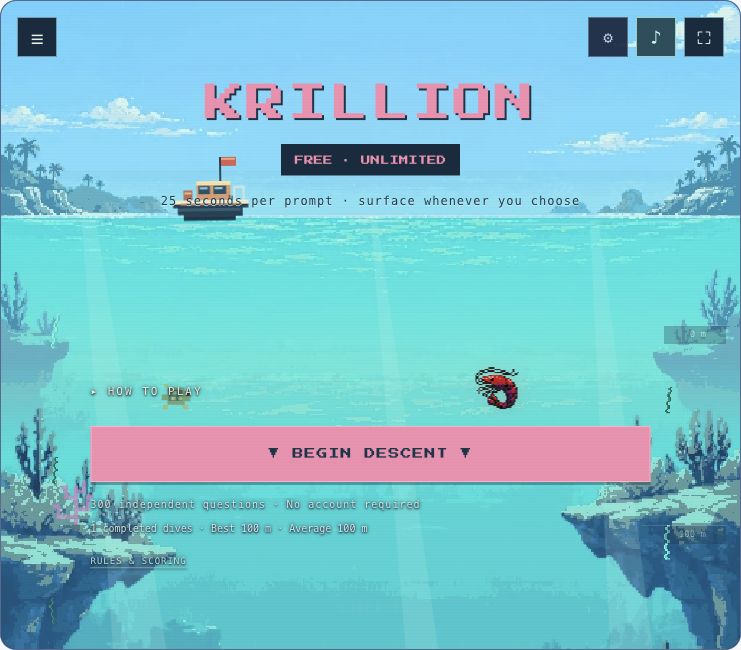 Krillion UnlimitedFree · 300 questions · 25 seconds per clue
KRILLION
Geography
FREE · 100 CLUES
25 seconds per clue · surface whenever you choose
▸ HOW TO PLAY
Type one valid place answer per clue. Six editorial tiers award 10, 15, 30, 60, 85 or 100 points; accepted aliases share the place’s score. Each point sinks you 10 metres. Unrecognized answers can be retried; when time ends, your current typed answer is checked. A three-second descent, then 25 seconds to answer. Correct answers continue automatically after feedback. Skipped questions go straight to the next prompt. Missed questions wait for Continue. Surface after your first result to settle, including during later questions. Each question appears once per expedition; the available sea ends when the bank is exhausted. Unfinished progress is saved on this device.
Preset editorial familiarity scores, not official scores or measured player rarity. Questions can repeat between dives.
Preparing your dive.
Your completed dives are saved on this device.
RULES & SCORINGDescending · the clock starts in 3
Accepted answers & sources
SAFELY SURFACED
REVIEW YOUR ANSWERS
Try another practice game
Krillion UnlimitedFree · 300 questions · 25 seconds per clueKrillion Geography Practice
Play 100 free geography clues with 25 seconds to name each place. Surface whenever you like, then review your answers.
Play the geography question bank
Type the place each clue identifies. Geography keeps its own saved dive and statistics, separate from mixed Unlimited.
How Geography scoring works in our game
Geography uses the same six tiers as our mixed Unlimited game. Each accepted place has one preset score, and its accepted spellings all earn that score. Every point moves your dive 10 metres deeper.
| Tier | Points | Depth gained |
|---|---|---|
| Plankton | 10 | 100 m |
| Too Clever | 15 | 150 m |
| Schooler | 30 | 300 m |
| Rare | 60 | 600 m |
| Deep Cut | 85 | 850 m |
| One in a Krillion | 100 | 1000 m |
These are editorial judgments about familiarity, not official Krillion points and not player-tested rarity. Too Clever marks a familiar supposedly obscure reference; One in a Krillion is an editorial gem, not a statistical claim. A difficult clue does not automatically make its answer rare. The current clues each identify one place, so a different obscure place does not earn points merely for being unusual.
Pick a geography area
Use these areas to organize your recall. They stay on this page; the game currently shuffles its full bank rather than offering area filters.
World regions
Start with a continent, then scan smaller regions. Check whether a clue asks for a sovereign country, territory, state or historical region. The bank includes countries such as Malawi and Eswatini and regions such as Yunnan; these place types are not interchangeable.
Capitals
Connect a capital to its country before reaching for a less familiar spelling. The current bank includes cities that are capitals, such as Warsaw, Seoul and Wellington, through specific historical or cultural clues. It is not a complete world-capitals test. A largest city, former capital or seat of government only counts if it fits the wording.
Oceans, lakes & rivers
Separate a sea from its ocean, a river from a city on its banks, and a lake from its surrounding region. Our Mediterranean Sea clue seeks the named sea; our Porto clue uses the Douro River to identify a city. These are different answer types. Lakes and rivers are also useful study cues, without implying a complete playable list of either.
Landmarks, peaks & islands
Distinguish the feature from the country around it. Stonehenge, Cocos Island and Yellowstone National Park are accepted targets in their own clues. Peaks are another useful way to organize recall, but this release does not promise a dedicated mountain question set.
Sample geography questions
These original open-category examples teach answer selection. They are not the playable single-target prompts or exhaustive accepted-answer lists. “Less familiar” below is an editorial comparison, not a measured rarity or promised score.
| Original question | Common answer | Less familiar answer | Why consider it? |
|---|---|---|---|
| Name a sovereign country in Europe. | France | San Marino | This small country is less prominent in everyday world-news recall, although its tiny size can make it a familiar clever choice. |
| Name a national capital in Europe. | Paris | Vaduz | Liechtenstein’s capital receives less attention than the major European capitals; it still has to satisfy “national capital.” |
| Name a river that flows through Germany. | Rhine | Spree | A regional river such as the Spree is a less immediate association than the widely known Rhine. |
| Name an island belonging to Ecuador. | Isabela | Floreana | A smaller Galápagos island can be less immediate to recall than the archipelago’s largest island. Both must satisfy the country qualifier. |
How to find an uncommon geography answer
The Unlimited recall method starts with a valid fallback, then changes the angle. Apply it carefully to geography:
- Change region, rather than difficulty. For an open country category, mentally scan another part of the specified continent instead of searching for a harder fact about your first country.
- Change era only when allowed. A historic place name can help recall, but a former capital does not satisfy “current capital.” In our game, an old name must also be a listed alias.
- Think of the smallest member. Small states, islands or tributaries can supply useful alternatives. Size is a memory cue, not proof of a high tier.
- Lock down every qualifier. Underline “country,” “city,” “national,” “current” and the regional boundary. On a single-target clue, use these constraints to identify its one intended place.
Get the correct place first. A less familiar answer outside the category cannot score. Read the rules and scoring guide for the shared game mechanics.
Accepted spellings and alternates
The checker applies Unicode NFKC normalization, trims leading and trailing whitespace, lowercases your answer and collapses repeated whitespace. For example, NEW ZEALAND normalizes to new zealand; that normalization alone does not make an answer valid for any clue.
Names still need to match a canonical answer or its explicit alias list. Diacritics and punctuation are not removed automatically. Kyiv / Kiev, Eswatini / Swaziland, Valparaíso / Valparaiso and İskenderun / Iskenderun are listed alternatives in their respective clues. These pairs earn the same score. Capital variants work the same way: a spelling listed for a Kyiv clue is not an alias for a different capital.
We do not accept every country abbreviation, translated name or historic label. SA is ambiguous; 中国 is not automatically converted to China; “Constantinople” is not automatically converted to Istanbul. A nearby city is also not an alternate: Osaka does not replace Nishinomiya in the departure clue, and Luján de Cuyo does not replace Luján.
If a valid-looking spelling is missing, try the conventional English name before the timer expires. A correction suggestion, when shown, is a hint rather than an automatic accepted answer. After settling, expand each round in Review Your Answers to see its exact accepted names and reference sources. Our answer guides explain why official reveal answers and our practice list can differ.
Krillion Geography vs the official packs
The official themed packs are published by the original Krillion game. Our Geography page offers independent free practice: 100 original typed location clues, the shared underwater UI, six editorial tiers and progress stored on this device. It does not import the official Geography answer pool or predict an official result.
The original game maintains its own answer sets, scoring and access rules. Consult its official FAQ for its curation approach. An official purchase does not unlock anything here, and our practice statistics do not sync to the original game.
FAQ
What categories does Geography cover?
The current 100-clue bank covers countries, cities, regions, islands, landmarks and named geographic features, often through history or cultural stories. The four area modules on this page are study guides, not selectable game filters.
How does Geography scoring work?
Plankton earns 10 points, Too Clever 15, Schooler 30, Rare 60, Deep Cut 85 and One in a Krillion 100. Each point adds 10 metres. These are our editorial familiarity scores, not official scores or measured player rarity.
Is Krillion Geography Practice free?
Yes. All 100 current clues, repeat dives, answer review and result cards are free. No account or purchase is required.
How long can I play?
Each clue has 25 seconds. A dive continues until you surface or finish the 100-clue bank. You can start another dive whenever you like; there is no daily play limit.
What happens if I answer incorrectly?
An unrecognized answer lets you retry while the same timer continues. Blank submissions are ignored. Skipping earns zero. When time expires, your current draft is checked once; an empty or unaccepted draft earns zero.
Which spellings are accepted?
Case and extra whitespace are ignored, and Unicode compatibility forms are normalized. Only the canonical name or a listed alias counts. Accents, abbreviations, translations and historic names are accepted only when explicitly listed for that clue.
Is this connected to the official Krillion Geography pack?
This is independent fan-made practice with its own questions, answer lists, scores and saved progress. Purchases and progress on the original game do not transfer here.
Will there be more tiers or geography packs?
There are six scoring tiers. No extra tiers or additional packs are announced here. Any future content will be reviewed for answer coverage before being added.
Can I resume a dive and review my answers?
Yes. Unfinished Geography progress saves in this browser on this device, separately from mixed Unlimited. After Surface & Settle, open Review Your Answers for accepted names, points and source links. Clearing browser storage removes local progress.
Do the sample questions appear in the game?
The open-category examples on this page explain how to think about geography answers. The current playable bank uses 100 precise single-target clues, so you cannot substitute another obscure place for the one a clue identifies.